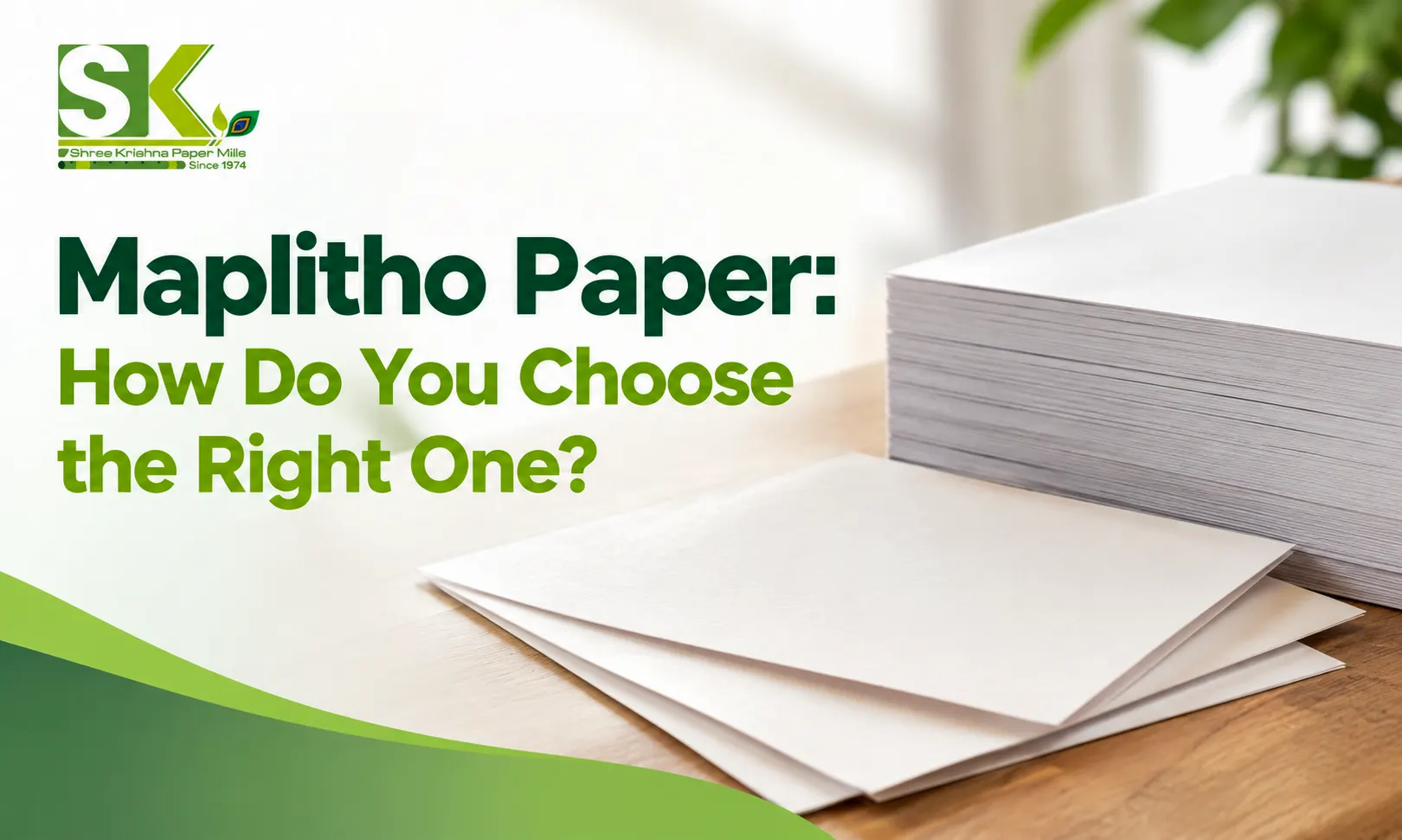
When you are buying Maplitho paper the first question should not be which GSM should I buy? It should be what I’m going to print on it? Paper used inside a textbook has different requirements than paper used for a brochure, notebook, or other commercial printing job. Once you know the application, you can narrow down the right GSM and then compare factors like opacity, thickness, and moisture stability. Maplitho is generally an uncoated printing paper commonly used for everyday printing and publishing. But the word Maplitho alone does not tell you everything about a paper. Different grades have different characteristics, so check the specifications before placing a large order.
How to choose the right Maplitho paper?
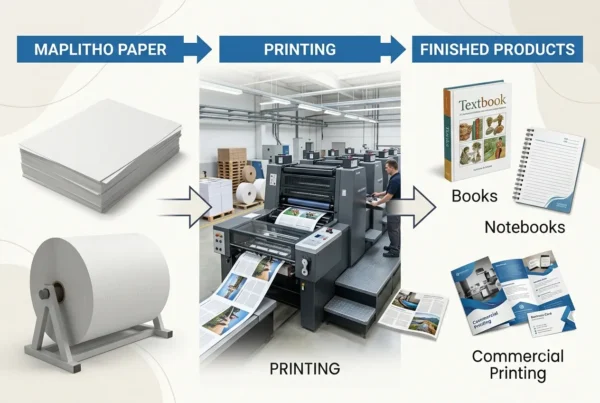
Choosing the right Maplitho paper becomes really easy when you work backwards from the finished product. Think about what the paper needs to do once it comes out of the printing press. Will it carry a lot of text? Will both sides be printed? Does the finished product need to be light and easy to handle?
What you are printing | What to pay attention to |
Books and textbooks | GSM, opacity, readability and thickness |
Notebooks | GSM, writing feel, opacity and bulk |
Forms and office printing | GSM, smoothness and print performance |
Brochures and commercial printing | Brightness, surface quality, GSM and print consistency |
Educational material | Opacity, brightness, readability and durability during handling |
Start with the application
If you are producing hundreds or thousands of copies, even a small difference in paper specification can affect the final product. A paper that looks fine when you hold a single sheet might behave differently when printed and bound in a complete book. For example, if you are printing a book with text on both sides of every page, opacity becomes important. If the paper allows too much ink from the reverse side to show through, reading becomes uncomfortable.
Then choose the gsm
Once the application is clear, you need to look at Maplitho paper GSM. It tells you the weight of the paper per square meter. It is useful for comparing papers, but it should not be the only specification you consider. 2 papers with the same GSM can still feel different because their thickness and density might vary. That is the only reason why it is better to treat GSM as one part of the buying decision rather than the complete answer.
What GSM is right for a Maplitho paper?
There is no single Maplitho paper GSM that works for every application. In general, lower GSM papers are lighter and can be very useful where you want to keep the finished product thin and easy to handle. Higher GSM papers provide more weight and can make the finished product feel more substantial. For books, for example, choosing a very heavy paper can quickly increase the thickness and weight of the finished book.
GSM and thickness are not the same thing. GSM measures weight per square meter, while thickness, or calibre, tells you how thick the sheet physically is. If you are buying paper for a large printing project, asking the supplier for a sample and checking the technical specification is much safer than choosing GSM based only on the product name.
What Is Maplitho Paper Used For?
The broad range of maplitho paper uses comes from its suitability for printed material, where an uncoated surface is preferred.
Some common applications include:
- Books and textbooks
- Notebooks
- School and educational material
- Office forms and documents
- Manuals and instruction material
- Letterheads and stationery
- General commercial printing
- Printed inserts and information sheets
The exact grade should still be selected according to the printing process and the required finish. For example, paper for books and notebooks usually needs to offer a comfortable reading or writing experience. Commercial printing can have different requirements, especially when the design contains graphics or larger areas of ink.
What specifications should you check in Maplitho paper?
Gsm
Gsm is the paper weight per square meter. It affects the weight and feel of the finished product and also helps you select a paper suitable for the intended application.
Opacity
It tells you how much light is blocked by the sheet. In simple terms it helps you understand how much printing from the other side might be visible. It is especially important for books, textbooks and documents printed on both sides.
Brightness
Brightness affects how the paper appears and can influence the contrast between the paper and the printed text. A suitable brightness level can help printed text and images appear clear.
Smoothness
Uncoated paper still comes in different surface qualities. Smoothness can affect how ink sits on the sheet and how the paper feels when handled. Consistent surface quality can contribute to more even printing and cleaner finished products.
Thickness
Caliper refers to the physical thickness of the paper. It becomes important when you are planning book thickness binding or the overall bulk of a printed product. You must remember that GSM and thickness are different measurements.
Moisture
Paper response to moisture and changes in moisture can affect how sheets behave during printing and handling. Good dimensional stability can help reduce issues like expansion and contraction or inconsistent sheet handling during production.
Fiber composition
Depending on the grade you also need to check the fiber composition. This can include information about virgin fiber or other specific composition. Fiber composition can affect the characteristics appearance and suitability for a particular printing requirement.
Maplitho versus wood free paper
The terms Maplitho versus wood free paper can sometimes create confusion because they are not necessarily 2 completely separate choices in a simple way buyers might assume. Maplitho is commonly used as a name for unquoted printing paper while wood free generally refers to paper made from chemical pulp rather than mechanical wood pulp. In practice paper grades can be described using more than one characteristic. So when looking at the difference between Maplitho and wood free paper you should not assume that one name automatically tells you how the paper will perform.
Should You Choose Maplitho or Wood Free Paper?
If you are wondering maplitho or wood free paper, compare the papers against the requirements of your printing job.
Look at:
- GSM
- Opacity
- Brightness
- Smoothness
- Thickness
- Moisture and dimensional stability
- Fibre composition
- Printing requirements
- Finishing and binding requirements
How to choose Maplitho paper for your printing application?
For books and textbooks
For books and textbooks you need to pay close attention to opacity and thickness. As many books are printed on both the sides we do not want the text from the next page interfering with readability. At the same time choosing paper that is unnecessarily heavy can make a large book bulky. For textbooks that will be handled regularly the balance between weight and thickness matters more than simply selecting the highest GSM available.
For notebooks
Notebook requirements depend on how the notebook will be used. A notebook intended mainly for writing needs a surface that feels comfortable with the chosen instrument. Both the sides of the page will be used, opacity becomes more important. For school or everyday notebook you might also want to consider the overall weight because students and users have to carry the finished product around.
For commercial printing
Paper for commercial printing can cover a wide range of products from forms and company stationery to brochures and promotional material. Here the paper should be selected according to the design and printing process.
Conclusion
So you need to know that choosing a Maplitho paper does not have to be complicated but it should go beyond picking a familiar GSM. You need to start with the job you need the paper to do. Then compare GSM opacity brightness thickness and moisture stability and fiber composition according to that application. For books and notebooks overall weight might be especially important.
For commercial printing surface quality and printing performance might deserve more attention. And when comparing Maplitho paper versus wood free paper look past the names. The actual grade and specification tells you much more about whether a paper is suitable for your project.