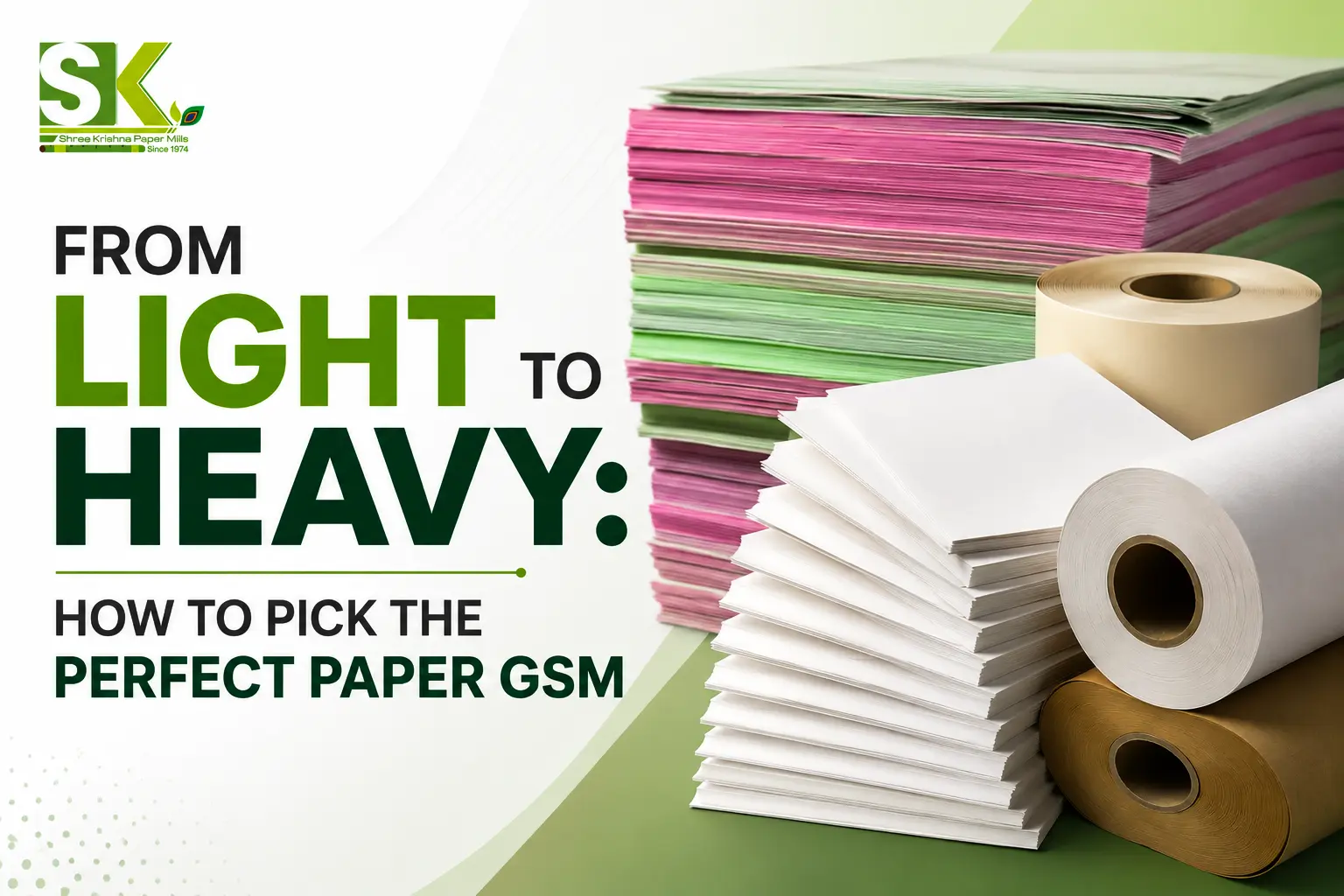
Is a higher GSM always a better choice? Not necessarily. The GSM of a paper tells you exactly how much a square metre weighs, but it doesn’t tell the whole story. A higher paper GSM can mean greater material consumption; however, some of the factors, like thickness, strength, fibre composition, and surface properties, along with the intended application, matter as well.
So, that’s why the right paper for packaging cannot be the right option for printing or even industrial use. Furthermore, price also depends on more than just its weight. In this blog, we’ll explore how to choose the right GSM, what other paper specifications to compare, and how these factors can affect cost.
What Does GSM Mean in Paper?
GSM stands for Grams per Square Metre. It is actually a standard measure of a paper’s grammage. It means the mass of one square metre of the material. So, it’s clear that a 100 GSM paper has a mass of 100 grams per square metre. Now, this measurement is generally listed on paper specification sheets, as it provides buyers and manufacturers a consistent way in order to identify and compare paper grades. ISO 536:2019 specifies the method of determining the grammage of paper and board.
However, GSM should not be confused with paper thickness. In our daily language, people mostly describe a sheet as “heavier” when they really mean it feels thicker or even substantial. Technically, GSM measures mass per area; on the other hand, thickness measures the physical distance between the two surfaces of the sheet.
This difference is essential when comparing paper GSM for different applications. Two papers can have the same GSM but different thickness, density, stiffness, and strength because of differences in fibre composition and manufacturing. So, while GSM is an important element of the paper specification, it should always be considered alongside other properties when choosing the right paper.
How to Choose the Right GSM for Your Paper Application?
Understand how to choose the right GSM of paper by comparing application needs, thickness, strength, and other key paper specifications. Here’s what to consider:
Printing Applications
The size of paper GSM must be matched to the type of print, handling, and end product when printed. Consider:
- Handling: Ensure the sheet feeds, stacks, and finishes properly.
- Print quality: The smoothness of the surface and the way the ink absorbs into the surface may impact the printed image.
- Opacity: Useful for minimising show-through in printing on both sides.
- Thickness: The thickness is checked in a calliper and not reflected by the GSM value.
- Final feel: Stiffness and finish are required based on the end product.
Packaging Applications
Packaging paper characteristics should meet the requirements of paper weight, strength, and converting performance. Consider:
- Strength: Match the grade to the load and handling conditions.
- Stiffness: This is important to help keep packages in shape.
- Folding and converting: Paper should be suitable for creasing, cutting, folding, and/or glueing.
- Product weight: Heavier product contents may need to have different performance characteristics.
- Transportation: Do take into account stacking, vibration, and handling at delivery.
Food Packaging Applications
GSM is just one component of the specification when it comes to food packaging. Selection should consider:
- Application: Requirements differ for dry, moist and oily products.
- Strength: The material has to be capable of resisting filling, handling and transportation.
- Barrier properties: Moisture or grease resistance may be necessary for the intended use.
- Converting: Assess suitability for forming, coating, folding or sealing.
- Food-contact requirements: Food-contact requirements must also be considered in line with applicable safety and regulatory requirements.
Industrial Applications
Paper performance may need to be higher for industrial use. Look at:
- Mechanical demands: Determine the forces that the material will be subjected to.
- Tear resistance: Important where the paper may experience pulling or rough handling.
- Strength: Select it according to the particular performance requirement and not just GSM.
- Calliper: Affects stiffness, bulk, and processing.
- Handling: Storage and transportation may impact performance; repeated handling can also impact performance.
GSM vs Paper Thickness: Are They the Same?
No. GSM and paper thickness are not the same measurement. The grams per square metre (GSM) is a measure of the mass of a square metre of paper; the thickness (also called caliper) is a measure of the actual thickness of the paper. Factors like fibre composition, density and manufacturing processes can influence caliper and this makes it possible for a paper that has the same GSM to have a different thickness.
The thickness of paper and board is measured according to ISO 534, and the grammage according to ISO 536. When the application requires stiffness, bulk, folding, converting, handling or the final feel of the paper, it is important to check both measurements for the paper buyer. So, GSM is the weight of paper per unit area and thickness is the actual thickness of the paper.
Does Higher GSM Mean Better Paper?
No, not necessarily. The higher the GSM, the higher the mass per square metre, but not necessarily the better the quality, strength or performance. The right GSM of paper is dependent on the application and its specific requirements such as strength, thickness, fibre or material properties, surface properties, moisture properties, and converting requirements.
For instance, surface and printability is a critical properties for a printing grade, while stiffness and strength are important properties for packaging. Thus, the correct paper GSM will be the one that fits into the technical and performance specifications of the application, yet does not contain any extraneous material or expense.
How Does GSM Affect Paper Cost?
GSM can impact paper cost, as it can be a measure of how much material is used on a selected area of paper. But it’s not the only thing that determines the actual cost. The paper grade, raw materials, specifications, manufacturing process, order quantity, and supply requirements may all affect the cost.
1. More Material Per Unit Area
The GSM of paper is a higher mass-to-area ratio. For instance, 1000 square metres of 100 GSM paper weighs approximately 100 kg, and the same area at 200 GSM weighs approximately 200 kg. This difference becomes relevant when purchases or consumption of paper is on a large scale.
2. GSM and Material Consumption
The higher the GSM of the paper, the more paper it will take to cover the same amount of space. This can lead to higher cost, but higher grammage might be needed when a stronger, stiffer, more opaque, or other performance parameter is demanded for the application. The intention should be to use the appropriate GSM specification and not just the lowest or highest available grade.
3. GSM Is Not the Only Cost Factor
The price of paper goes beyond just GSM. The final price may vary by paper grade, fibre composition, size, order quantity, manufactory needs, finishing, packaging, logistics, and market conditions. Hence, it is advised that buyers to compare the full specifications of papers along with the value of paper instead of the GSM.
What Should Buyers Check Along With GSM?
GSM provides you with the mass per unit of surface area, but not the performance of the paper. When choosing a grade, compare the GSM of the paper with the properties that are relevant to the use. The properties of paper and board that TAPPI measures are key properties that are evaluated with the materials.
1. Thickness / Caliper: The thickness of the sheet is displayed by a calliper. It can vary in bulk, stiffness, folding and handling characteristics and can vary in different types of paper that have the same GSM.
2. Strength Properties: Inspect the relevant strength properties: tensile, tear, burst, or compression. There is no direct correlation between GSM and the strength of paper.
3. Moisture: Paper can be affected by moisture in size, strength, feeding, and processing. Moisture conditions are critical, especially in cases of storage and/or fluctuations in moisture.
4. Surface Properties: Smoothness, formation, coating and absorption may affect print quality, coating and finished product appearance.
5. Absorption / Cobb Where Relevant: The Cobb value might be indicative of water or moisture absorption in applications where the product comes into contact with water or moisture. It offers helpful information that GSM cannot.
6. Tolerance and Consistency: Verify the consistency of GSM and other key characteristics throughout the sheets and run. For high-volume printing and industrial applications, consistency may be even more crucial.
GSM Selection & Cost Checklist for Buyers
A helpful final checklist:
- Application: What will the paper be used for?
- What do you need in order to have a grammage?
- Thickness: Does a calliper matter?
- Performance: What force or handling would be appropriate?
- Specifications: What other properties are important?
- Tolerances: What degree of variation is considered acceptable?
- Price: How much will the total cost be for the required specification and quantity?
- Supplier: Is the manufacturer able to provide relevant technical and quality information?
Conclusion
GSM is a good place to begin, but proper paper choice is more than just a number on a specification sheet. The right grade is a compromise between paper weight, thickness, strength, surface characteristics, consistency, application requirements, and overall cost.
The method will prevent over-specification and performance problems and will facilitate procurement. For paper applications where paper evaluation assistance is required, SKPMIL’s decades of experience in paper manufacturing will guide you toward making a paper selection decision.